
If you have spent any time scrolling through dating apps lately, you have probably noticed a strange phenomenon: everyone seems to be exactly the same. Thousands of people apparently "love to laugh," "enjoy the outdoors," and are "just as happy staying in with a movie as going out." While these things might be true, they don't actually tell you anything about the person behind the screen. When you are writing your own profile, the pressure to sound appealing often leads you to reach for these safe, generic phrases. You want to come across as likeable, but in doing so, you might accidentally erase the very things that make you "you."
The reason many profiles end up sounding like a carbon copy of one another is a natural desire to fit in and avoid judgment. It feels risky to be specific. However, a profile that sounds like everyone else is much harder to respond to. If you give someone a list of clichés, you aren't giving them a hook to start a conversation. Writing a profile that actually sounds like your real-life self isn't about being the most exciting or impressive person on the app; it’s about being recognisable. You want someone to meet you for a coffee and feel that the person sitting across from them is exactly who they expected after reading your bio.
"Authenticity is about the choice to show up and be real. The choice to be honest. The choice to let our true selves be seen."
Authenticity matters because it sets the foundation for a real connection. When you try to sound more adventurous, more intellectual, or more "easy-going" than you actually are, you end up attracting people who are looking for a version of you that doesn’t exist. This usually leads to awkward first dates or a feeling that you have to maintain a performance. By writing naturally, you filter for the people who will actually appreciate your specific brand of company.
How to write a profile that feels specific and natural
The secret to a great profile is "Show, Don’t Tell." Instead of using empty labels like "active" or "creative," describe what those things look like in your daily life. Think about how you would describe your weekend to a friend. You wouldn't say, "I am a person who enjoys gastronomy and socialising." You would say, "I spent Saturday morning looking for a decent sourdough before heading to the pub for the football." The latter gives a much clearer picture of your personality and your lifestyle.
Consider these examples of how to turn generic statements into something more personal:
- Generic: "I love travelling and spending time with friends."
- More personal: "I’m happiest planning a weekend away, finding somewhere good to eat, and convincing friends to stay for one more coffee."
- Generic: "I’m active and enjoy keeping fit."
- More personal: "I usually start Saturday with a walk or a swim, but I’m equally happy abandoning ambitious plans for a long lunch."
- Generic: "I like all kinds of music and going to gigs."
- More personal: "My record collection is a slightly embarrassing mix of 80s synth-pop and jazz, and I’m always looking for someone to join me at the local independent venue."
- Generic: "I enjoy cooking."
- More personal: "I’m excellent at making a mess in the kitchen while trying a new curry recipe, though I’m still working on getting the spice levels right."
When you use specific examples, you make it incredibly easy for someone to message you. Instead of a generic "Hey, how are you?", they can ask about your favourite record shop or recommend a place with great sourdough. You are providing "conversation starters" rather than just a list of facts. Humour can also be a great tool, but only if it genuinely reflects your style. You don’t need to be a stand-up comedian; sometimes a self-deprecating comment about your inability to keep a houseplant alive is more endearing than a rehearsed joke.
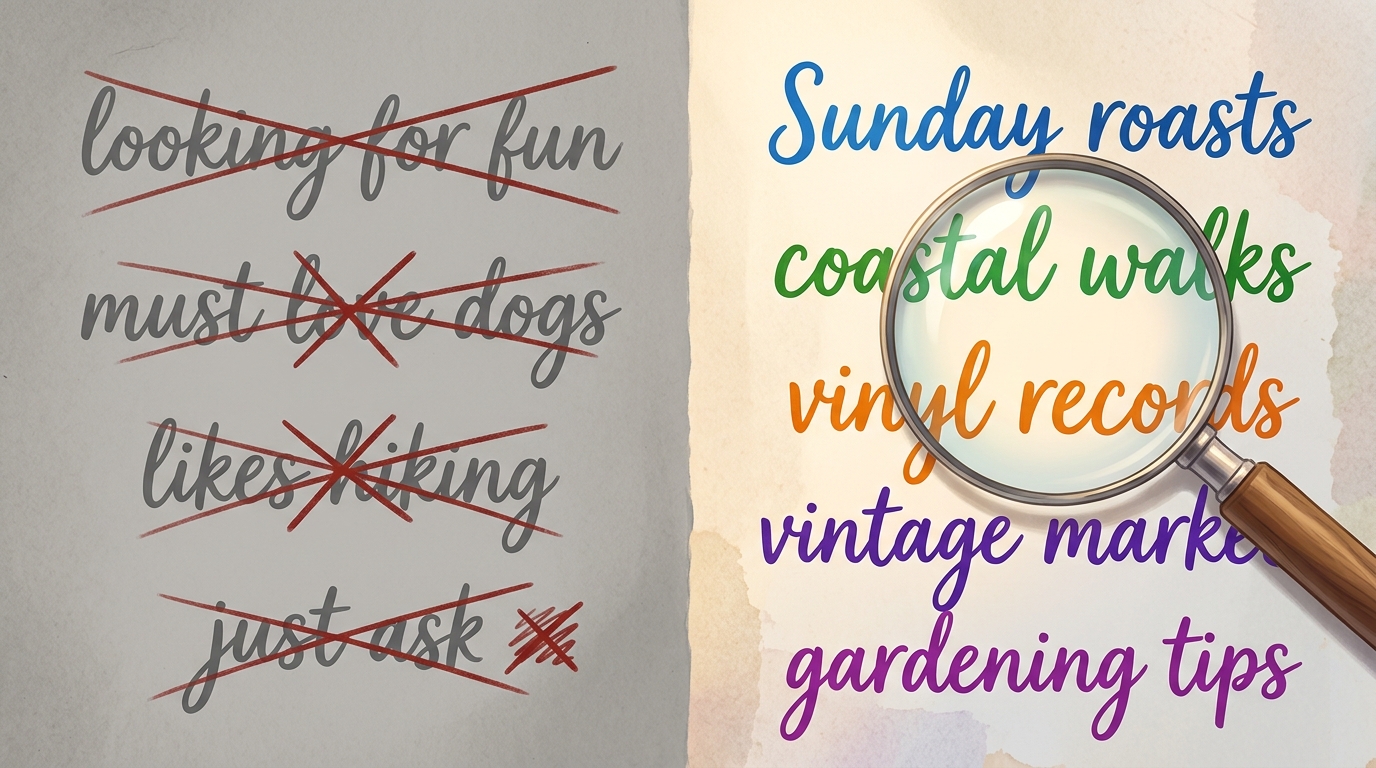
Regarding the length of your profile, aim for a "Goldilocks" approach: not so short that you seem disinterested, but not so long that it feels like a memoir. A few well-crafted paragraphs or a series of punchy bullet points are usually enough to give a sense of your rhythm and tone. If you find yourself writing a long list of requirements for a partner, try to flip it. Instead of saying "Must love dogs, must be fit, no smokers," try "I’d love to find someone who wants to join me and my terrier on Sunday hikes." It says the same thing but feels welcoming rather than demanding.
A Note on Honesty: It can be tempting to exaggerate your interests to seem more "exciting." If you went hiking once three years ago, don't list yourself as an "avid hiker." If you actually prefer quiet nights with a book, say that. There are plenty of people looking for exactly that, and they will be relieved to find someone who shares their pace of life.
What to include, what to avoid and when to update it
While honesty is vital, it should be balanced with privacy and positivity. You do not need to share your life story or your deepest insecurities in a public profile. According to safety guidance from the Online Dating Association (ODA), you should always avoid including identifying details such as your workplace, your home address, or specific routines that could allow someone to track your location. Keep the initial focus on your personality and what you enjoy doing in the public sphere.
One of the biggest mistakes people make is including negativity about past relationships. Phrases like "No time-wasters," "Looking for someone who isn't obsessed with their ex," or "My last relationship was a disaster" are immediate red flags for many. Even if your experiences have been frustrating, putting that frustration in your bio makes you seem bitter or guarded. Keep your tone positive and focused on the future. Focus on what you *do* want, rather than what you are trying to avoid.
Here are a few things to check for when you are revising your profile:
- Tone Check: Read your profile out loud. Does it sound like you speaking, or does it sound like a cover letter for a job? If it feels too formal, swap some of the longer words for the ones you actually use in conversation.
- The "So What?" Test: Look at every sentence. If a sentence is a cliché (like "I work hard and play hard"), ask yourself: "What does this actually mean for me?" and replace it with a real-life example.
- Freshness: If your profile has been the same for six months, it might be time for an update. Our interests change with the seasons. In winter, you might talk about your hunt for the best Sunday roast; in summer, you might mention your attempts at gardening or coastal walks.
- Clarity: Be clear about what you are looking for without being rigid. Whether it’s a long-term relationship or just seeing where things go, being upfront saves everyone time and ensures you are meeting people with similar intentions.
Finally, remember that a dating profile is a living document. It doesn't have to be perfect from the first day. If you find that you are attracting the "wrong" kind of messages, it might be a sign that your profile is giving off a different vibe than you intended. Don't be afraid to tweak it. The best profiles are those that feel like a snapshot of a real person's life—flaws, quirks, and all.
You don't need to be clever, and you certainly don't need to be impressive. You just need to be you. A strong profile gives someone a realistic sense of what a Tuesday evening or a Saturday morning with you might feel like. It sets a comfortable stage for a first conversation, making the transition from a digital screen to a real-life meeting feel much more natural. By being specific and staying positive, you aren't just looking for any match—you are looking for the right one.